

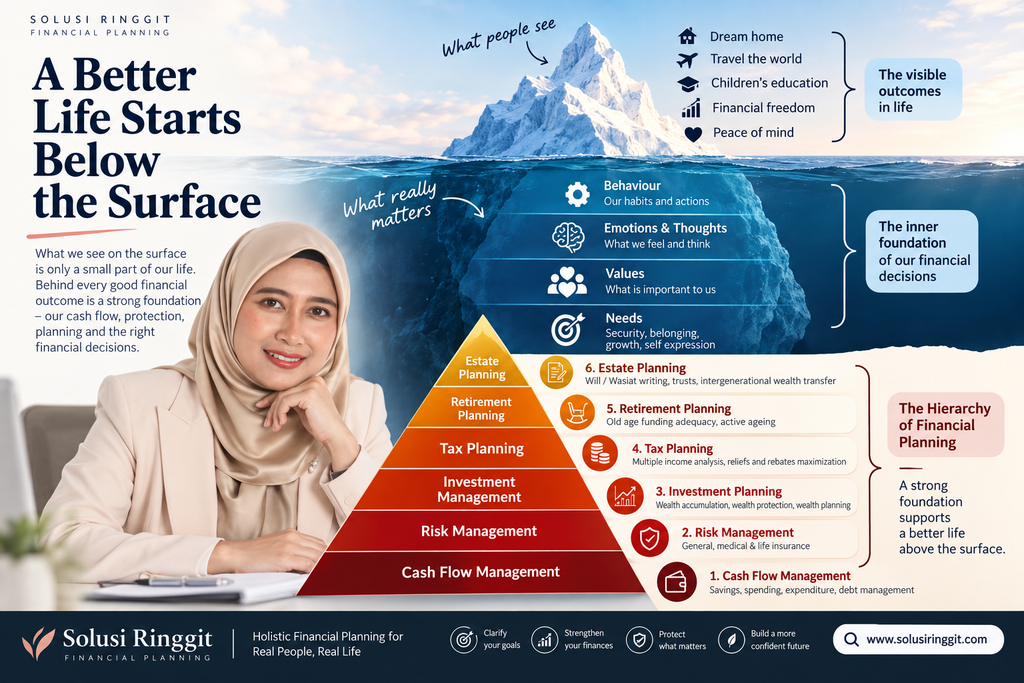
When people hear the words financial planning, Pyramid of Financial Planning often leads them to think about investments.
Which unit trust should we buy within Pyramid of Financial Planning? Should we invest in property? Should we increase our EPF contribution? Should we diversify into stocks, private investments or other assets?
These are valid questions. But they are not necessarily the first questions we should answer.
Holistic financial planning works differently.
We look at a person’s finances as an interconnected system. Before discussing how much return an investment could generate, we need to understand whether the financial foundation supporting that investment is strong enough.
This is where the Hierarchy of Financial Planning becomes important.
A strong financial plan is built in layers.
Cash flow forms the foundation, followed by financial resilience and risk management.
Within the Pyramid of Financial Planning, wealth accumulation follows.
Retirement, education funding, property ownership, estate planning, and other long-term objectives follow.
Only after these foundations are addressed should we move toward those goals.
This distinction matters because having investments does not automatically mean that someone has a strong financial plan.
Financial Literacy in Malaysia: Knowing About Money Is Not the Same as Having a Financial Plan
Financial literacy remains an important issue in Malaysia.
A survey by financial education platform Multiply involving 3,333 respondents found that only 31% were classified as a “Money Boss”, referring to respondents who understood basic financial concepts well. Another 21% were classified as Finance Newbies, while 48% were Finance Cadets. Combined, almost 70% of respondents were considered to need some level of financial literacy support.
The numbers are useful because they highlight an important distinction:
Earning money is one skill. Managing money is another.
A professional may earn RM15,000, RM20,000 or even RM30,000 per month and still experience financial pressure if expenses, commitments, debt and lifestyle increase at the same speed.
Similarly, someone may own several investment products yet remain financially vulnerable because there is insufficient liquidity when an emergency occurs.
Financial planning therefore should not begin with:
“What investment should I buy?”
It should begin with:
“How strong is my financial position today?”
Malaysia’s financial education agenda increasingly reflects this broader view. Bank Negara Malaysia has highlighted financial capability and financial resilience under the National Strategy for Financial Literacy 2026–2030, with an emphasis on helping Malaysians make informed financial decisions across different stages of life.
That is also how we approach holistic financial planning.
The Financial Planning Pyramid: Why Cash Flow Comes First
If we imagine financial planning as a pyramid, cash flow sits at the bottom.
There is a simple reason for this.
Cash flow is to our finances what the heart is to the human body.
When the heart functions properly, blood flows throughout the body and supports every organ.
In the same way, when cash flow is healthy, money can be directed towards:
- daily living expenses,
- emergency savings,
- debt repayment,
- insurance and takaful,
- children’s education,
- investments,
- traveling,
- property ownership,
- retirement planning,
- tax and zakat commitments, and
- estate planning.
When cash flow is constantly under pressure, every financial objective above it becomes more difficult.
This is why we do not only ask:
“How much do you earn?”
We also need to understand:
“Where does your money go?”
A person earning RM20,000 but spending RM19,500 every month may have less financial flexibility than someone earning RM10,000 while consistently retaining RM3,000 after expenses.
Income alone therefore does not tell us whether someone’s financial position is strong.
The relationship between income, expenses, debt, savings and available surplus matters much more.
Step 1: Understand Your Cash Flow Before Building Wealth
Before building an investment portfolio, we first establish what is happening to the client’s money every month.
This normally requires us to identify several areas.
How much income is coming in?
How much is fixed?
How much is variable?
How much goes towards lifestyle expenses?
How much is committed to loans?
How much is regularly saved?
How much is invested?
And importantly:
How much money is actually left after everything has been paid?
The remaining surplus determines how quickly many other financial goals can realistically be achieved.
For example, a person might tell us:
“I want to accumulate RM2 million for retirement.”
The retirement objective may be reasonable.
But before calculating investment returns, we need to establish whether the person currently has the monthly capacity required to fund that objective.
This is the difference between having a financial goal and having a financially executable plan.
Step 2: Build Emergency Reserves and Financial Resilience
Once cash flow is understood, we look at financial resilience.
An emergency fund is not exciting.
It does not generate the type of returns that people like to discuss when talking about investments.
But it performs one of the most important jobs in financial planning:
It gives us time and options when something unexpected happens.
Consider situations such as:
- retrenchment,
- a sudden reduction in income,
- an unexpected medical expense,
- urgent home repairs,
- major vehicle repairs,
- family emergencies, or
- temporary inability to work.
Without accessible savings, these events can quickly lead to credit-card borrowing, personal loans or premature withdrawal from long-term investments.
And financial resilience remains a very relevant concern.
A 2026 financial resilience study by Sun Life Malaysia reported that 70% of respondents said they would not be able to cope beyond six months if they suddenly lost their income.
This illustrates why liquidity cannot simply be ignored while pursuing investment returns.
Step 3: Review Debt and Financial Ratios Before Buying Property
Property is another area where financial planning can provide a valuable second opinion.
The first question should not necessarily be:
“Can the bank approve my loan?”
The more important question is:
“Can my overall financial plan comfortably support this property?”
Loan eligibility and financial affordability are not always the same thing.
Before purchasing a property, we may review financial ratios and several factors such as:
- existing debt commitments,
- debt service obligations,
- disposable income,
- emergency reserves,
- liquidity,
- existing assets,
- current housing commitments,
- potential renovation costs,
- maintenance fees,
- assessment and quit rent,
- insurance or takaful costs,
- expected changes in family expenses, and
- the client’s ability to continue servicing the property if income falls.
We also consider gearing.
A client may technically qualify for another housing loan, but taking that loan could significantly increase financial commitments.
We then need to ask:
What is the client’s holding power?
Can the client continue servicing the property if it remains vacant?
What happens if interest or financing costs increase?
What if one household income disappears?
What if a major repair occurs?
What if the client wants to change career?
A property decision should therefore be evaluated not only based on whether the property is attractive, but also on how the purchase affects the rest of the client’s financial life.
Step 4: Risk Management Protects the Plan
This is the layer that many people underestimate.
Imagine that a client tells us:
“I want to travel overseas every year.”
Or:
“I want RM10,000 per month when I retire.”
Naturally, we can calculate how much the client needs to save.
But before focusing entirely on those targets, we need to ask another question:
What could prevent this plan from happening?
This is where risk management becomes part of financial planning.
A financial plan cannot assume that income will continue uninterrupted for the next 20 or 30 years.
Life may change.
A critical illness may occur.
A disability may affect someone’s ability to work.
A breadwinner may pass away prematurely.
A business may experience difficulty.
An employer may restructure.
A professional may face retrenchment.
A previously stable household income may suddenly fall.
These events do not only create an immediate financial problem.
They can also destroy long-term goals.
Money that was supposed to fund retirement may suddenly need to fund living expenses.
Investments intended for children’s education may need to be liquidated.
Travel plans may disappear.
A property may become difficult to maintain.
This is why we review insurance, takaful and other risk-management arrangements within the context of the client’s overall financial plan.
The objective is not simply to accumulate