

Sometimes, the value of financial planning is not found in a single retirement number.
Consider factors like job stability and potential loss of employment when planning for future security.
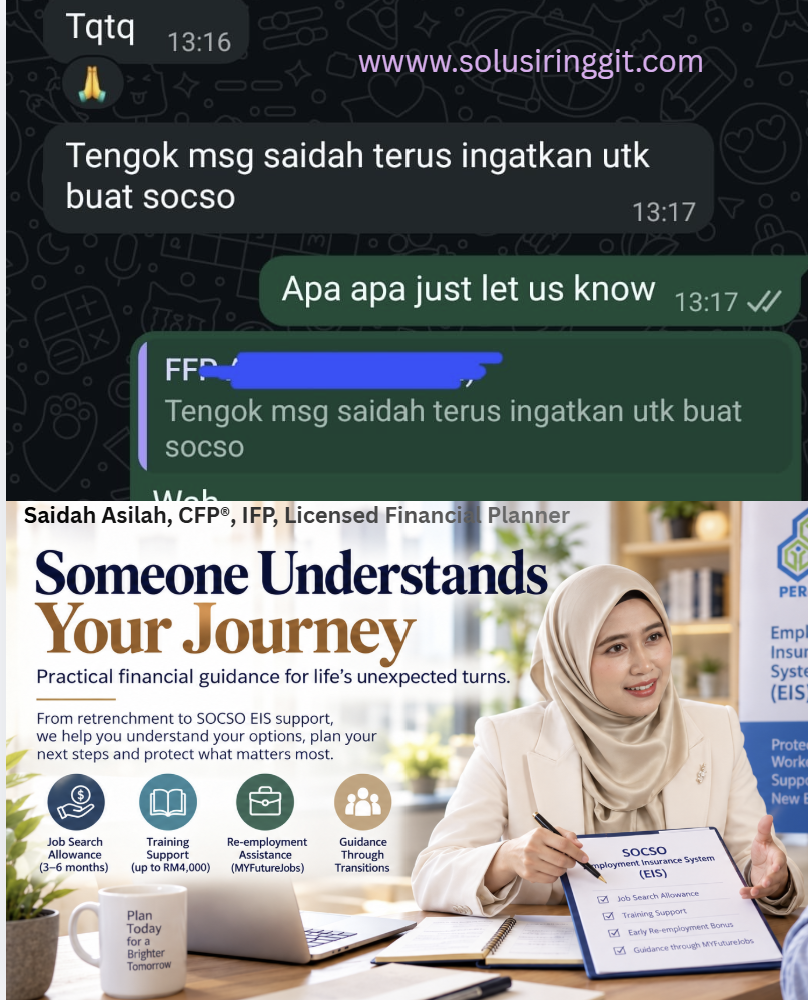
Sometimes, a simple message at the right time discusses loss of employment.
Recently, we received a WhatsApp message from a client that stayed with us.
It discussed loss of employment and its impact.
“When I saw Saidah’s message, it immediately reminded me to apply for SOCSO.”
It was a short message. But behind those words was something much bigger.
The client had gone through loss of employment—a period when income uncertainty, family commitments, monthly bills and the pressure of finding another job can arrive at the same time.
During our earlier financial planning discussion, we had gone through his situation and highlighted the importance of checking his eligibility for PERKESO’s Employment Insurance System (EIS), or System Insurance Pekerjaan (SIP).
He acted on that reminder.
Later, his application was approved, and he began receiving the relevant Job Search Allowance under EIS.
For us, that was an important reminder too.
Financial planning is not always about creating more money. Sometimes, it is about making sure someone does not overlook financial support that is already available to them.
And during a difficult transition, having someone who understands your financial journey can make a meaningful difference.
Losing a Job Is Not Only an Employment Problem
When someone loses a job, our first instinct is often to think about replacing the salary.
“How quickly can I get another job?”
That is important, but from a financial planning perspective, unemployment creates several problems simultaneously.
The person may still have:
A housing loan or rental.
Car installments.
Insurance and takaful contributions.
Children’s education expenses.
Parents who depend on them financially.
Credit-card commitments.
Household expenses.
Medical costs.
And perhaps most importantly, a family whose lifestyle was built around the previous monthly income.
This is why we do not view retrenchment simply as an employment issue.
We see it as a cash-flow event, emergency-fund event, protection event and financial decision-making event happening at the same time.
When income suddenly stops, the question should not immediately be:
“Which investment should we withdraw first?”
A better sequence is:
What financial resources are already available to support the household before we start dismantling long-term plans?
That may include emergency savings, retrenchment compensation, unused annual-leave payments, insurance benefits where applicable, available employment benefits and government social-security programs such as PERKESO’s Employment Insurance System.
What Is the SOCSO Employment Insurance System (EIS)?
Malaysia’s Employment Insurance System, administered by PERKESO/SOCSO and also known as LINDUNG KERJAYA, was established to provide income replacement and employment assistance for insured persons who lose their employment.
It is more than simply an unemployment payment.
PERKESO explains that eligible insured persons may receive income-replacement benefits while also receiving re-employment assistance. Applicants are required to participate in job-search activities through MYFutureJobs, and eligible recipients may also access training support.
This distinction is important.
EIS is intended to provide a temporary financial bridge while the individual works towards returning to employment.
It is therefore not a replacement for emergency savings or long-term financial planning. But during unemployment, it can reduce the amount that a household needs to draw from its own savings.
And that can be significant.
Who May Be Eligible to Claim EIS After Losing a Job?
Eligibility should always be confirmed directly with PERKESO because every employment situation is different.
According to PERKESO, applicants generally need to:
apply within 60 days from the date of loss of employment;
meet the applicable Contribution Qualifying Conditions (CQC); and
experience a loss of employment that falls within the definition under the Employment Insurance System Act.
Examples of loss of employment recognized by PERKESO include normal retrenchment, VSS/MSS, business closure or bankruptcy, constructive dismissal and certain resignations involving workplace threats, sexual harassment or dangerous duties outside the employee’s job scope.
However, not every departure from employment qualifies.
PERKESO identifies exclusions such as voluntary resignation, expiry of a fixed-term contract, retirement, completion of a specified project and dismissal due to misconduct.
This is exactly why we encourage clients not to make assumptions.
Do not assume:
“I resigned, therefore I definitely cannot claim.”
Or:
“I was retrenched, therefore I will automatically receive EIS.”
Check the actual circumstances and obtain confirmation from PERKESO.
The 60-Day EIS Deadline Is One Detail We Do Not Want Clients to Miss
This is perhaps one of the most important practical points.
An EIS application generally needs to be made within 60 days from the date of loss of employment.
During retrenchment, however, 60 days can pass surprisingly quickly.
The first few weeks may be occupied by:
updating a CV,
attending interviews,
settling matters with the previous employer,
adjusting household expenses,
dealing with emotions,
explaining the situation to family,
contacting recruiters,
and trying to determine what should happen financially.
An administrative deadline can easily become an afterthought.
That was why the client’s WhatsApp message meant something to us.
Our reminder did not create the SOCSO benefit.
The benefit was his entitlement subject to PERKESO’s eligibility assessment.
What the reminder did was encourage action.
And sometimes, in financial planning, that is exactly what clients need.
Not another complicated financial product.
Not another projection.
Just someone who remembers:
“Have you submitted this yet?”
How Much Can EIS Job Search Allowance Pay?
For an eligible recipient, the Job Search Allowance (JSA) may be payable for between three and six months depending on the applicable contribution qualifying conditions. Perkeso
PERKESO currently states that JSA is calculated using the insured person’s assumed monthly wage, with the payment rate reducing over time:
Month 1: 80%
Month 2: 50%
Month 3: 40%
Month 4: 40%
Month 5: 30%
Month 6: 30%
where the recipient qualifies for the corresponding payment period.
The actual entitlement depends on the individual’s circumstances and contribution record.
For a first claim, for example, the Employment Insurance System Act links the benefit duration to the number of qualifying contributions within the relevant 24-month period. Someone meeting 12–15 months of contributions may qualify for three months of payment, while 24 months of qualifying contributions may support six months, subject to the applicable rules.
This is why we would not simply tell a client:
“You will receive six months.”
We would say:
“Let’s check how many months you actually qualify for and plan your cash flow based on the confirmed entitlement.”
That is a more responsible way of planning.
EIS Is More Than a Monthly Allowance
Another commonly overlooked point is that PERKESO’s employment protection goes beyond Job Search Allowance.
Eligible EIS recipients may potentially have access to several forms of support.
Early Re-employment Allowance
If a JSA recipient returns to employment before exhausting the remaining allowance, PERKESO provides an Early Re-employment Allowance equivalent to 25% of the remaining unpaid JSA entitlement, subject to the program’s requirements.
This is designed to encourage an earlier return to employment rather than discourage job seeking.
Training Support
Eligible JSA recipients may also be referred for vocational or skills training after consultation with an Employment Services Officer.
PERKESO states that eligible training costs of up to RM4,000 may be borne by EIS.
A training allowance may also be available at a daily rate determined by the recipient’s previous assumed salary and attendance requirements.
Employment Assistance Through MYFutureJobs
EIS recipients are also connected to employment services and job-search support through MYFutureJobs.
This matters because the purpose of EIS is not merely to replace part of someone’s income.
It is to help the individual transition back into employment.
Why We Check SOCSO Before Telling a Client to Withdraw Their Investments
Imagine someone has been retrenched.
Their monthly household expenditure is RM8,000.
They still have RM100,000 in investments.
The immediate reaction may be:
“I have investments. I can withdraw from them.”
Technically, they can.
But that does not automatically mean they should.
Those investments may have been accumulated for:
retirement,
children’s education,
a future home,
or another long-term financial goal.
Selling investments during unemployment may also mean selling at an unfavorable market value.
Instead, we prefer to look at the household’s available financial resources systematically.
A typical sequence might involve checking:
employment compensation → EIS eligibility → available cash → emergency reserves → temporary expenditure adjustments → other accessible resources → investment withdrawals only where necessary.
The precise order depends on the individual.
But the principle is important:
Do not unnecessarily sacrifice a long-term financial asset to solve a short-term cash-flow problem before checking what other legitimate resources are available.
A Financial Planner Cannot Prevent Retrenchment, but We Can Plan Around Its Consequences
Financial planning cannot guarantee that someone will never be retrenched.
We cannot guarantee that the next job will arrive within two weeks.
We cannot control the economy, an employer’s restructuring exercise or the labor market.
What we can do is prepare the household to respond.
For someone who has just lost employment, our conversation may therefore be very different from a normal investment review.
We may need to discuss:
How many months can the household survive without the salary?
Which expenses are essential?
Which commitments can temporarily be reduced?
Should voluntary investment contributions continue?
Should loan repayments be restructured?
What benefits are available through SOCSO/PERKESO?
How much emergency cash should remain untouched?
Which investments are liquid if withdrawals eventually become necessary?
Does the spouse’s income cover the family’s essential expenditure?
What happens to medical insurance or takaful that previously depended on employment benefits?
These questions are interconnected.
A client might initially come to us worried about investments.
But when we look deeper, the most urgent issue might actually be cash-flow resilience.
Financial Planning Is Sometimes About Protecting the Decisions You Already Made
When someone has spent ten or fifteen years accumulating retirement savings, investments and emergency funds, unemployment should not automatically erase all that progress.
The objective during a temporary income disruption is often to protect as much of the existing financial structure as reasonably possible while helping the family move through the transition.
This is where an EIS benefit can have a wider financial impact than the amount received each month.
If that allowance helps cover groceries, utilities, transportation or part of the mortgage for several months, perhaps the client does not have to withdraw the same amount from investments.
Perhaps the emergency fund lasts longer.
Perhaps the spouse feels less pressure.
Perhaps insurance coverage can remain intact.
Perhaps the client has more time to look for an appropriate role instead of accepting the first available job purely because cash is running out.
The allowance itself may be temporary.
The financial decisions it protects can have much longer consequences.
“I Saw Your Message and Immediately Remembered to Apply for SOCSO.”
This was the sentence that inspired us.
Because it reminded us what clients sometimes value about having a financial planner.
They may not remember every regulation.
They may not remember every deadline.
And during a difficult period, they may not have the mental space to think about every available option.
Sometimes our role is simply to say:
“Please remember to check this.”
Then, when the client later tells us the application went through and the allowance has started coming in, we see something important.
Financial planning is not only about numbers.
It is also about continuity.
Someone understands the financial journey you have been building.
Someone remembers why that emergency fund exists.
Someone knows which financial goals should not be disrupted unnecessarily.
Someone can help you look at the consequences of one decision against another.
And sometimes, someone sends the right reminder at exactly the right time.
If You Have Recently Been Retrenched, Start Here
If you have recently experienced loss of employment in Malaysia, do not spend the first few weeks focusing only on finding another job.
Treat it as a financial transition that requires an immediate action plan.
First, confirm your official last date of employment and check your EIS eligibility with PERKESO as soon as possible, particularly because the application period is generally limited to 60 days from the date of loss of employment. Perkeso
Then gather your employment documents and review your monthly cash flow.
Identify the amount required to maintain essential household commitments.
Separate essential spending from spending that can temporarily be postponed.
Review your emergency savings.
Check what insurance, takaful and medical benefits may change after employment ends.
Understand your retrenchment or termination compensation.
And only after seeing the entire financial picture should you decide how much of your savings or investments need to be used.
Retrenchment does not automatically mean your financial plan has failed.
It means the assumptions have changed.
And when assumptions change, the plan needs to change with them.
The Bigger Lesson: A Financial Plan Should Work When Life Does Not Go According to Plan
The strongest financial plan is not necessarily the plan showing the highest projected investment return.
It is the one that can continue functioning when life becomes inconvenient.
When someone loses a job.
When a child unexpectedly needs money.
When a parent becomes financially dependent.
When medical expenses appear.
When income changes.
When retirement arrives earlier than expected.
These are the moments when financial planning becomes real.
For our client, the immediate outcome was straightforward:
He remembered the SOCSO/EIS application.
He took action.
His eligibility was assessed.
And he subsequently began receiving the allowance he qualified for.
But the deeper lesson is one we carry into every client conversation.
Good financial planning is not simply about telling people where to put their money.
It is about understanding where they are going, recognizing when circumstances have changed, helping them see the options available to them and making sure important financial actions do not quietly fall through the cracks.
Sometimes people do not need someone to tell them they should have prepared better.
They need someone who understands what they are going through and helps them determine:
“What can we do from here?”
That is the kind of financial planning relationship we believe matters.
At Solusi Ringgit Financial Planning, we help professionals and families look at their finances holistically—from cash flow, emergency reserves and wealth accumulation to retirement, insurance and risk management, estate planning, tax and zakat planning, and personalized financial roadmaps.
Because when life changes unexpectedly, a financial plan should not simply tell you what you had intended to do.
It should help you decide what to do next.
Information on PERKESO/EIS benefits in this article reflects official PERKESO information available as of September 2026. Eligibility, contribution requirements and actual benefits depend on individual circumstances and PERKESO’s assessment. Applicants should verify their entitlement directly with PERKESO.